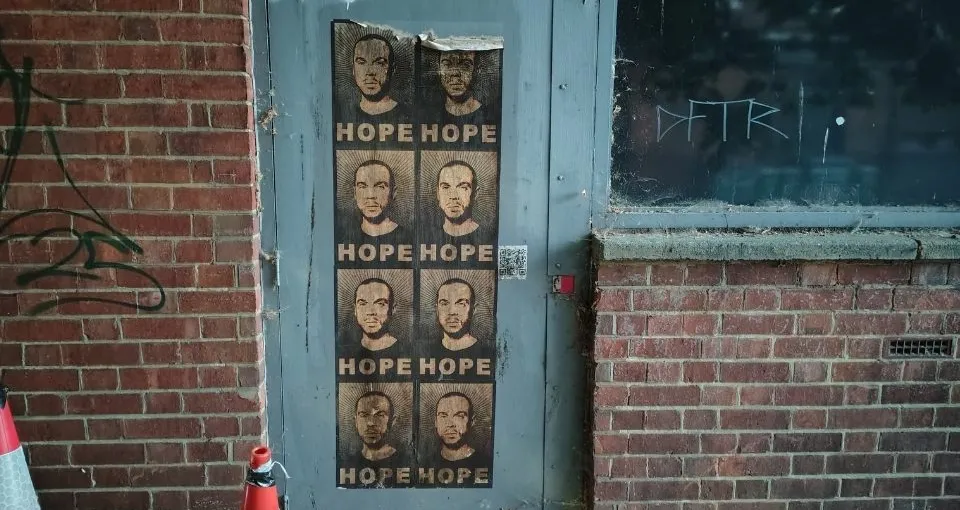
Hope
Hope
Dear Luca, today I’d like to write you about hope.
Yes because even if this world is “going to the dogs” as someone would say there are signs of hope. First I want to show you how bed it is. Then I’ll introduce you to the hope.
A big problem
You know, my family is a working class family with mortgages to pay. In 2022 Me, my brother and my mum we all had a mortgage to pay with a variable interest rate and at that time the inflation was very high so the ECB started aggressively to increase the rates. That increase was an existential threat to my family because our monthly payments soared by hundreds of Euros each months. Around that same period I remember receiving my annual bonus from my job (a few thousands, nothing crazy) but I was astonished to see that banks were offering me a 5% rate on those deposits. It was so unfair. The rates on my mum’s mortgage soared to 5-6% causing my old mum to worry and work extra-hours while at the same time it was rewarding me just because I had liquidity (a few clicks on my app). The system was rewarding me with just a few clicks because I had liquidity while drowning people like my mum who actually needed the most. It felt my old mum was financing my new extra income.
Wealth inequality
This big problem is wealth inequality, who owns the “means of productions”. I’m referring to the “necessary assets and resources that enable a society to engage in production”. Factories, the land, labor, resources. Unfortunately these days we could even argue that they are increasingly owning the “means of survival” because everything is being privatized and owned by the few. Just consider that today the UK’s 50 richest families hold more wealth than 50% of the ~69 Milions UK’s citizens. The following chart shows the trend of the wealth share in the US (thanks twopoints.blog).
The chart shows how the wealth started dropping for the bottom 90% and skyrocketing for the top 0.1% after 1980.
Amore mio, in period of crisis the ultra rich experience abundance and prosperity while the wealthy-poors experience fear and solitude.
The next chart shows the growth of the richest person in the world. In 2018 you will notice that the line decrease and it’s because Jeff Bezos got divorced forcing him to give away a substantial share of his wealth to his wife. Nevertheless he still remained the richest man on earth until 2021 and in only 1 year he regained back all of his wealth. Today Elon Musk (first trillionaire) is worth as much as the GDP of Switzerland (not a poor country).
Only 19 countries on around 220 have a GDP higher than the wealth of Elon Musk.
Wealth inequality is tricky
You can’t have a democracy withouth economic rights.
Political influence
Political influence can be considered an asset. And you can’t compete against a trillionaire. The bottom class is getting squeezed out from it too. Zero political representation means less protection for your interests. Welfare is not an interest of the ultra wealthy, it’s often seen as a cost for them. Pension, healthcare, public goods, social cohesion and stability are jeopardized. We’ll be left alone fighting against predatory super powerfull international elites. And of course they will win.
Ultra wealthy pay less taxes than you on each new euro they gain. This represent a compounding advantage that widen the inequality (aka injustice).
Compounding advantages
As the chart shows the ultra wealthy pay less taxes than you for every euro they accumulate in wealth. This means that as an owner of a small ecommerce that sells for example ornamental plants I will pay more taxes in percentage than Jeff Bezos who owns Amazon. And they achieved this along the latest decades. You, us, experienced crisis while they were experiencing abundance and prosperity like never before. After a certain level of wealth, your family is safe for generations. The priority switches from “having enough to retire” to power grab. Hence, the billionaires increasingly spend for political influence and media influence to control the narrative. Some say that the 4th pillar of democracy (press and news media) don’t exist anymore. RSF (reporters withouth borders) says “in 25 years, the average score of all 180 countries and territories surveyed in the Index has never been so low” Here.
Sovereign Wealth
Another important aspect of wealth inequality affected the wealth of the nations. As a brilliant italian Economist (Gabriele Guzzi) once put it, “the only acceptable way to use the adjective “sovereign” in public discourse is near the word “Debt”. Nations used to own a lot of wealth, now more and more they own a lot of debts. The following chart shows the Government Debt as a share of GDP. As we can see all of the major economies in Europe massively increased this ratio. This means that these governments today own less wealth and have to pay higher interests to the bond holders. Having a higher debt increase the interest rates which in turn increase the flow of money from the government to the debt collectors.
This trend have 2 important implications, first markets (who buy the government bonds) determines if a policy is acceptable or not. And these are not Democratic forces. Secondly, nations are poorer and they have to increase taxation or decrease the welfare spend. It’s a deadly loop.
Final thoughts on the problem
You might be wondering, Is it Ok to be rich? Yes of course. Is it Ok that 90% of the population will never be able to buy a house or have a pension? No, that’s not ok.
The world of my parents was not so rutheless. They lived in a world where if you work hard, even as a truck driver, you can have dignity, a family, a house, a pension and even go on holiday. That world is gone. It doesn’t exist anymore. I have a master Degree in Finance, my partner has a PHD from an american university and together we are barely able to buy an old flat in an ex-council house. Ah and with the help of our parents of course.
Hope?
Caro Luca, You might be wondering why the title of this article is “HOPE”. Are you crazy dad? Fighting against billionaires is not easy. They own the media, they finance the think-tanks that goes on the telly telling you that it’s your fault if you are poor. They control the public debate.
It’s a “asymmetrical” battle.
So, where is the hope?
Amore mio, the HOPE is PEOPLE. And their initiatives. And them, working together.
People
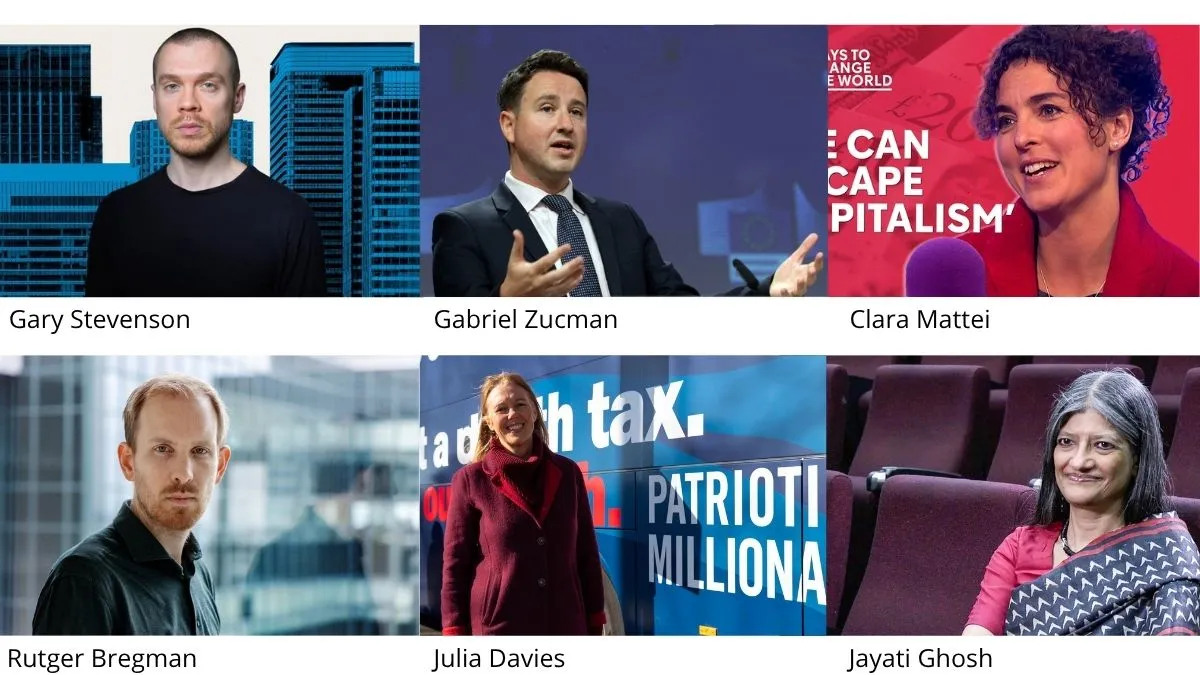 I grouped in this picture the most important figures that awakened my mind in the last years on this topic. Let’s crack on.
Firstly, Gary Stevenson. He’s probably the most unlikely figure. I studied finance, I know that people in Finance don’t empathize with the poor. He’s a former City trader,and among the many things he did, he has a huge youtube channel, he wrote a fantastic book, already best seller in the UK, called “the Trading game”, he released a documentary available on youtube on wealth inequality [Britain’s Inequality Problem…And How To Solve It | How To Get Filthy Rich ]. He also debated everybody enriching the debate and exposing flaws from the “billionaire-class” narrative.
Gabriel Zucman, a brilliant academic, head of the tax observatory of the EU, who just released a book titled “We Need to Tax Billionaires”. The book argue in favour of a 2% tax on wealth higher than 100 M€. In France the “Zucman tax” is also the name of a real policy proposal for an annual 2% minimum effective wealth tax on ultra-high-net-worth individuals. He extensively study and exposed the existing inequality in taxation of the ultra riches. He worked with Bernie Sanders and other politicians to shape a fairer taxation system.
Clara Mattei another brilliant academic, wrote a book called “Escape From Capitalism”. I discovered her on Youtube. She advocate extensively to review our current capitalistic system and see all of the distortions and inequalities that it produces. “Enduring problems such as poverty and inequality are not accidents or bugs in the economy, but core features – justified with pseudoscientific models to support a system that unfairly rewards people with the most resources”
Rutger Bregman is an historian and wrote many books. I discovered him because once at the WEF forum he surprised everybody with an historical speech about taxes. He cofounded The School of Moral Ambition, “a foundation dedicated to helping ambitious people take on the world’s most pressing problems. We pick the causes others overlook — factory farming, Big Tobacco, unfair tax systems — and empower small groups of driven idealists to solve them.”
Julia Davis is a British angel investor, environmental fund founder, and founding member of Patriotic Millionaires UK, a group advocating for higher taxes on the super-rich to reduce wealth inequality and fund public services. I discovered her on youtube too, she almost made me cry when she spoke about the need to fund the NHS. It’s incredibly powerful when a powerful person takes your side. I felt the warmth.
Jayati Ghosh is a Professor of Economics at the University of Massachusetts Amherst, she wrote many books and she is a member of several international boards and commissions including the UN High-Level Advisory Board on Economic and Social Affairs, the WHO Council on the Economics of Health for All, and the UN Secretary General’s High-Level Advisory Board on Effective Multilateralism. I discovered her through the documentary of Gary Stevenson. “A major counter-argument to a wealth tax is that millionaires will flee the country. In the documentary, Jayati Ghosh refutes this premise. She argues that while a small minority do leave, the vast majority stay because their social, cultural, and business ties to the country far outweigh the desire to avoid paying tax.”
Conclusions
This problem is gigantic. But people like the ones I listed are making the difference. In the UK a YouGov survey for Oxfam showed that 78% of the public support a 2% wealth tax on assets over £10 million, with 77% preferring taxes on the rich over public spending cuts. LINK
A lower Gini Index (less inequality) makes the world hospitable also for the rich. It’s safer and generally better to live in a society where everybody has dignity. Extremely unequal societies are also the more unsafe.
Polling commissioned by Patriotic Millionaires UK revealed that 75% of surveyed millionaires are willing to pay higher taxes to properly fund public infrastructure and social services [LINK]
To conclude, what gives me Hope is that we are gaining more and more class consciousness and we are starting to fight back. This issue is particularly insidious because it grows exponentially, it’s hard to campaign for (taxes have a “bad rep”) and it involves asymmetrical forces. But we are still winning the debate, at least in the UK. As a dad I want to be optimistic for your future and I will try to do my little part too. I will support taxing the ultra wealthy. I will campaign for it. And I will try to convince my friends too. If you are a dad, or just a human, please spread the message too.
To you My son, Love you.